On May 14, Zed published a blog post explaining what Anthropic's June 15 billing change means for its users. Buried in the second paragraph is the sentence the whole AI coding industry has been avoiding: "Claude subscriptions previously subsidized agent usage at roughly 15-30x compared to API pricing, and the new credits are billed at full API rates." Theo Browne, who runs T3.gg, put the consequence in plainer English on X — anyone running claude -p in CI or piping work through tools like Conductor or Zed's agent panel has effectively had their usage cut by 25x.
That is the story. The $200 Claude Max and Codex Pro plans most developers think of as "the AI bill" have never been priced against the work agents actually do. They were priced for a world where you asked a chatbot questions. The bill has been catching up quietly for two years. Anthropic just made it visible.
The number nobody publishes
The AgenticMesh post The Brutal Reality of Token Economics does the arithmetic Anthropic and OpenAI will not. Using Anthropic's own published rates ($3 per million input tokens, $15 per million output for Sonnet) and a 60% cost-of-revenue assumption, the provider's serving cost lands around $3.24 per million blended tokens. That means the $200 Max plan breaks even at 62 million tokens a month.
Real coding-agent users are not at 62 million. They are at hundreds of millions. AgenticMesh cites a Disney internal dashboard where one Claude power user burned 234 million tokens in nine working days. Jellyfish, which tracks engineering metrics across hundreds of companies, reports a median of roughly 140 million tokens per month for active Claude Code developers, with top adopters at 975 million tokens per week.
Run that through the math:
- At 150 million Sonnet-equivalent tokens a month, the user pays $200 and the provider eats around $486 in compute. Implied subsidy: $286/month.
- Swap to Opus and the same workload costs the provider roughly $810. Implied subsidy: $610/month.
Implicator ran a parallel estimate in March and arrived at the same shape: a $200 Max subscriber running Claude Code intensively was costing Anthropic close to $570 in compute. The exact figure varies with model mix, cache hits, and how aggressively the agent loops. The direction does not.
Anthropic publishes per-token API prices to four decimal places. It has never published the figure a Claude Code subscriber would actually need: how much compute a flat plan buys. As Implicator put it, the omission is not an oversight.
Here is what it looks like on my own machine. Over the last 30 days of normal coding work (not a benchmark, not a stress test, just the work), claude and codex reported the equivalent of roughly $2,000 in metered usage against my Max plan. I pay $200. The other $1,800 is the subsidy the AgenticMesh and Implicator numbers describe, made personal.
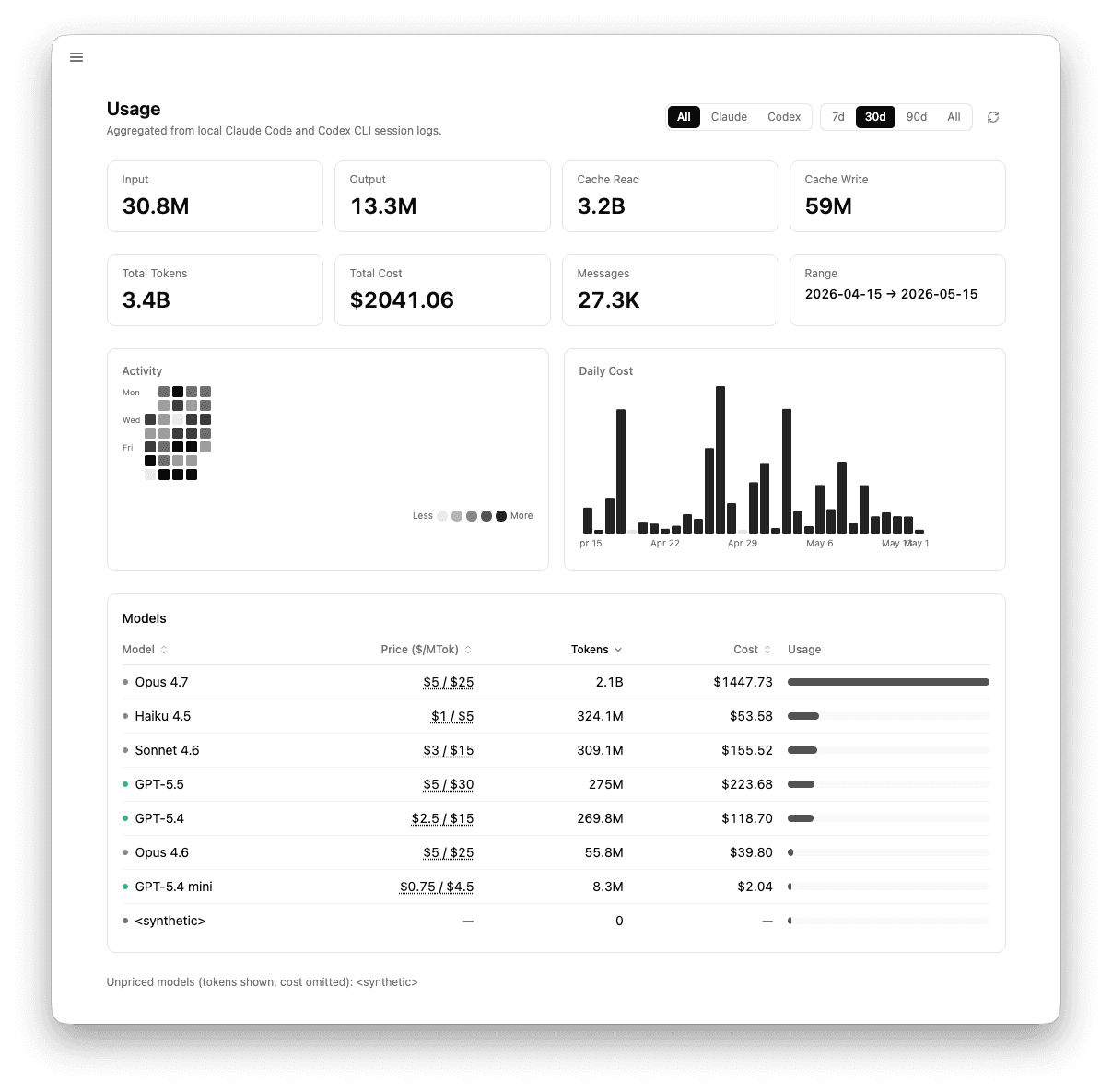
That is one developer doing one developer's work. Multiply across an engineering team and the gap between what subscriptions charge and what compute costs is not a rounding error.
This already happened once
If you want to know what the next twelve months look like, look at Cursor.
In June 2025, Cursor moved from a 500-requests-a-month model to credit-based metered billing. The same $20 plan now bought roughly 225 effective requests instead of 500. Cursor staff acknowledged the hardest requests could cost ~10x simple ones because newer models burn more tokens on longer-horizon tasks. A Hacker News commenter reported $350 in overage in a single week, roughly $1,400 a month against a mental model of $20.
The CEO issued a public apology on July 4, 2025 and offered refunds. By then Cursor's Trustpilot score had fallen to 1.7 out of 5 across more than 200 reviews.
GitHub did its own version of the same trick a few weeks later, pausing new signups on the flat-rate Copilot plan. The underlying tension is identical everywhere: subscriptions were priced for people asking questions, then those same subscriptions started being used to run agents for hours at a time.
What Anthropic actually changed on June 15
The June 15 split is sharper than Cursor's because it does not touch the interactive case. If you sit in front of claude or codex in a terminal and type, you still use the subscription pool. If anything programmatic is involved (claude -p, the Agent SDK, Conductor, the old OpenClaw passthrough, third-party agent wrappers), you now draw from a separate monthly pool: $20 of Agent SDK credits on Pro, $100 on Max 5x, $200 on Max 20x, billed at full API rates. When the credits run out, you either pay overage at API price or your requests stop.
Boris Cherny, who runs Claude Code at Anthropic, was direct about why: third-party tools operating outside the cache system are, in his words, "really hard to do sustainably." The Register reported the change the same day Zed did.
This is the third subscription rewrite from Anthropic in six weeks. April 4 banned third-party agents from subscriptions outright. April 21 briefly removed Claude Code from the Pro plan before backlash reversed it. May 14 announced the credit split that takes effect June 15. The pattern is consistent. The subsidy is being closed in stages.
How Zed is handling it
Zed's post is worth reading in full because it is the cleanest published reaction so far. Their answer is to give users three escape hatches:
- Run Anthropic's official
claudeCLI directly inside Zed's terminal. The CLI is still on the subscription pool, so usage is unchanged. The Zed agent panel that called Claude through the SDK is what hits the new credit ceiling, not the CLI. - Use Zed's built-in agent with a different provider: DeepSeek, Ollama, anything that supports the ACP protocol.
- Plug in any other ACP-compatible agent.
The unspoken argument is that the protocol is the thing worth defending, not any individual vendor relationship. Zed kept its UI and let the user choose where the inference happens. That is the same instinct behind what we do at IBERANT.
Our answer: Churro Coder
We built Churro Coder to give you the choice rather than making it for you.
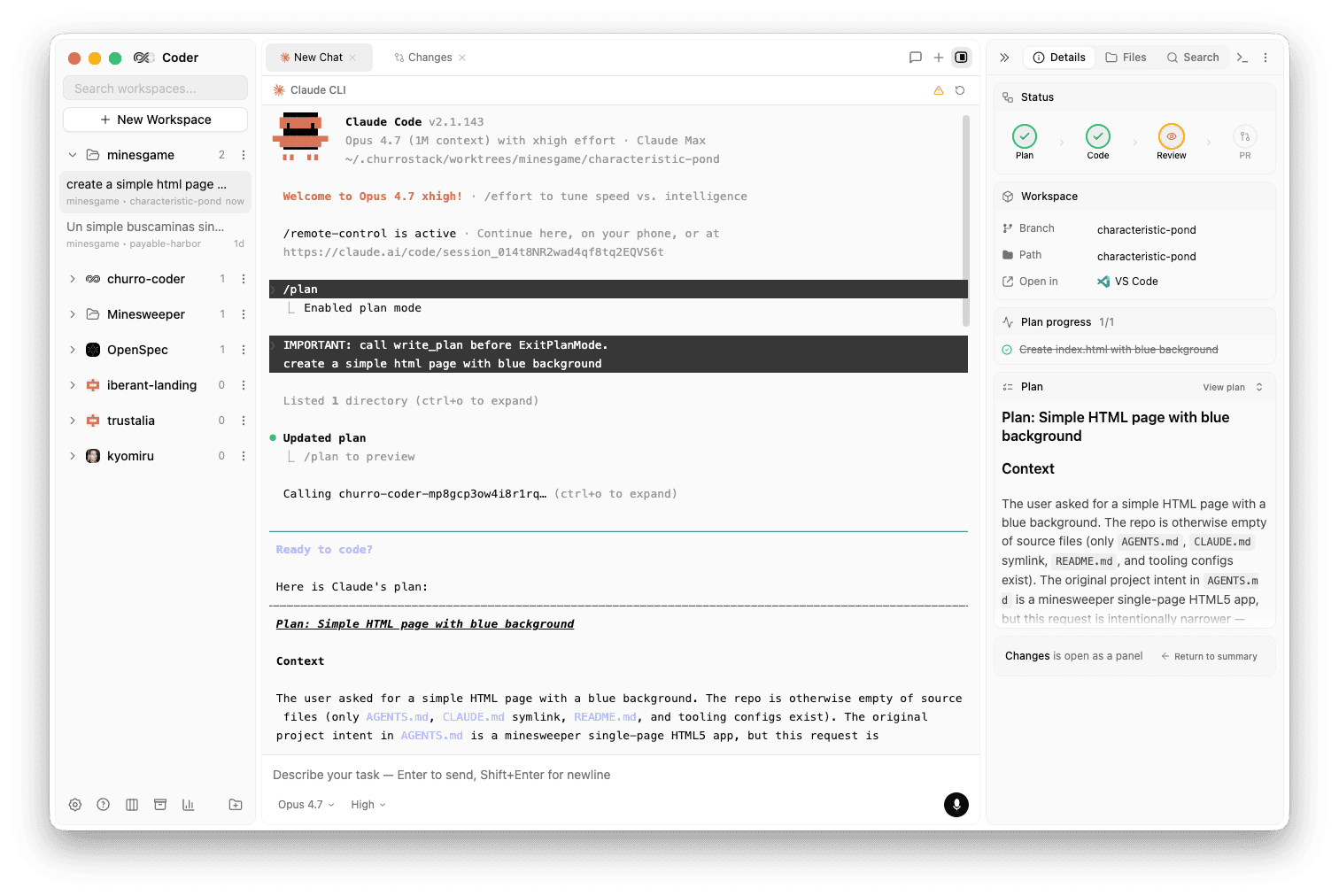
Churro Coder uses the Agent SDK, and it also embeds the native claude and codex CLIs as subprocesses inside a terminal built into the UI. The two modes cost very differently. If you run work through the Agent SDK path, you are on metered API billing. If you run it through the embedded CLI, you stay on your subscription pool — the same economics shown in the screenshot above, $200 for what Anthropic would charge $2,000 at API rates. You pick which one fits the task.
The UI stays consistent either way:
- Plan view, so you can read the agent's intended changes before they touch a file.
- Code-review approval, so diffs go through the same kind of inspection a teammate's PR would.
- OpenSpec workflow, so spec-driven work has somewhere to live that is not a 4,000-token wall of context.
The terminal embedding matters because most visual wrappers force you off the native CLI entirely. Churro Coder does not. You can keep using claude and codex exactly as Anthropic and OpenAI ship them, with their caching and subscription accounting intact, and still get the visual layer on top.
The subsidy closes
The economics that produced "use as much intelligence as you can fit through a $200 subscription" are the economics of a market that was buying market share with venture money. Anthropic's revenue is approaching a $7 billion run rate and the 2025 gross margin target was 40%, and that was after inference costs came in 23% over plan. OpenAI's structure is similar. Neither company can keep paying $600 of compute to collect $200 of revenue from the heaviest tenth of its users.
What that means for anyone shipping software with these tools: pick the workflow that keeps you on the cheap side of the metered line for as long as that line exists, and assume the line moves again. The interactive CLI is cheap today. The Agent SDK was cheap last month. Something else will be cheap next year.
Winter is coming. The $200 you pay today for a full month of AI-assisted coding could easily be $2,000 by next year — not because the tools got worse, but because the subsidies that made them affordable are running out. Plan accordingly.
If you want to see what living on the cheap side looks like in practice, try Churro Coder. If you want to talk about how to organize an engineering team around tools whose pricing keeps moving, let us know.